
PLOS One staff editor Johanna Pruller joined the Cancer Prevention Research Conference 2025 in London, UK, organized by Cancer Research UK and…
Impressions of a broad CANVAS
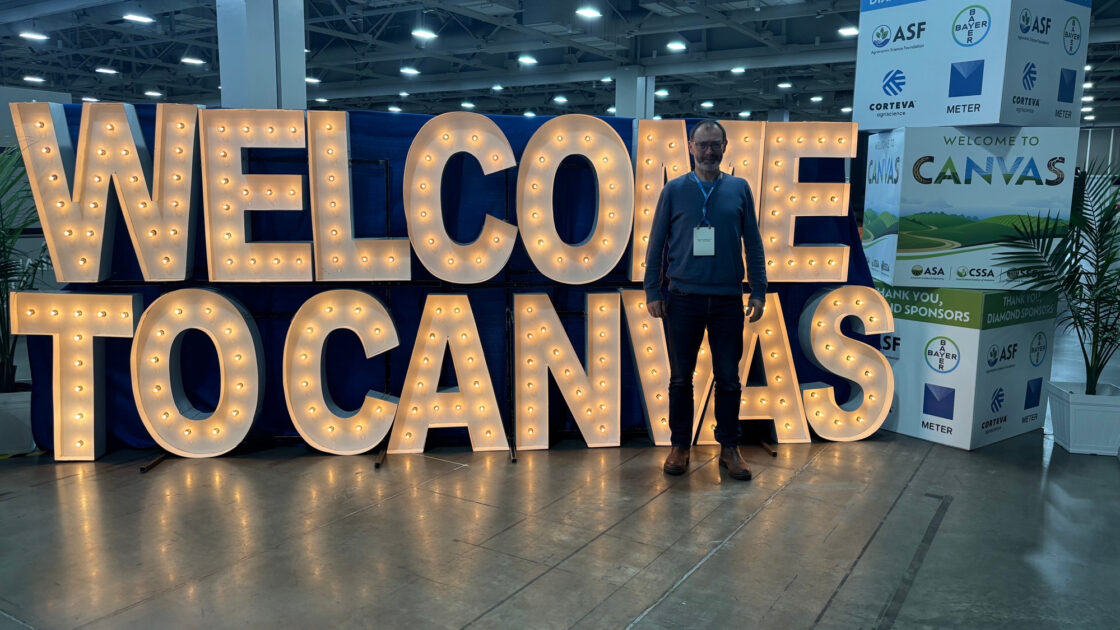
Posted on behalf of PLOS One’s Life Sciences Division Editor Patrick Goymer
The American Society of Agronomy (ASA), Crop Science Society of America (CSSA), and Soil Science Society of America (SSSA) have held their annual meetings together for decades, but last year this was rebranded as CANVAS – where Crop, Agronomic, Environmental, and Soil Sciences connect. This new name emphasizes both the inter-related nature of these fields, and the unifying environmental theme.
This year’s meeting took place on November 8-12 in Salt Lake City, and was attended by nearly 4000 delegates. Symposia were already well under way and many connections had been made by the time we sat down for the formal opening on Sunday evening. But this gave a great opportunity to look both back and forward. We began with a moving land acknowledgement from Honey Rhonda Duvall, founder of the Natives Aiming to Succeed Education Resource Center, along with singers and dancers, celebrating the Indigenous Peoples of this area. This was followed by a highly entertaining Back to the Future reenactment by the presidents-elect of the three societies, framing their thoughts on how agriculture and the three societies might look in 40 years. Finally, Asmeret Asefaw Berhe chaired a future-predicting panel discussion between Jayson Lusk, Stella Salvo and Scott Shearer looking at agronomic, economic, technological and social trends. Unsurprisingly, AI featured big in a lot of these discussions, with its influence ranging from data collection and integration to remote sensing to the control of precision agriculture.
The sessions over the next three days ranged widely across the interests of all three societies. Highlights for me included hearing about the use of CRISPR and other genetic technologies in developing new crops, improving our detailed understanding of environmental-yield interactions through soil biotic and physical effects, spillover effects of conservation efforts, weed control strategies in the wake of glyphosate-induced resistance, a survey of the funding landscape for crop research, and a fantastic memorial lecture from Merritt Turetsky on the interplay between fire, water, ecology and emissions in the long-term Alaskan peatland experiment. I was pleased to see use of open science practices in several cases, such as preprints – in this case of the talk itself, and in this case the use of a technique in a preprint by another speaker – and also open code, for example for a methodology for efficiently predicting linkage disequilibrium. It was also good to see some of PLOS One’s Academic Editors presenting at the conference, which provided the opportunity to catch up with them and thank them for their important service to the community.
Each of the three societies hosted a plenary talk (at the robust time of 7am!). First up was Behzad Ghanbarian for SSSA, who gave an overview of the history of soil physics, before looking forward to possibilities such as domain-trained LLM for soil sciences that enables bridging of siloed sub-disciplines. I was encouraged by his championing of open-source data, giving the example of it enabling the spatiotemporal analysis of extreme precipitation events. Second was the ASA, with Mitch Hunter offering one of the most optimistic takes on future sustainability that I’ve seen in a while. The main message was the benefits of continuous living cover, citing data from Minnesota on a diverse range of new crops. Finally, the CSSA plenary was from journalist Roger Thurow, who gave us an overview of his recent book Against the Grain, with its individual stories from sustainable farmers around the globe. It was also an opportunity for many delegates to pick up a free copy.
Students, including undergraduates, make up a sizeable proportion of the delegates. I was really happy to have the opportunity to be on the judging panel for the SASES (Students of Agronomy, Soils, and Environmental Sciences) agronomy competition, in which groups of 4-5 students had 7 minutes to present their solution to an agricultural problem. These fascinating talks ranged from how to improve quality control of peanut harvests, to reducing the environmental impact of nutrient loss, to generational succession planning for family farms. The conference also ran various training courses for students and more senior researchers alike. Given their emerging importance across disciplines, it was great to see that one of these was on how to conduct robust Systematic Reviews and Meta-analyses (SRMAs) in agriculture.
For more details of this inspiring conference, their feed on LinkedIn collates posts from various delegates. There was less activity on Bluesky than I’ve seen at other meetings, but what there is can be found here.