

This blog post was prepared by PLOS One Associate Editor Katherine Kokkinias. As telemedicine becomes more ubiquitous in healthcare across the globe…
Behind the Papers: Fascination of Plants Day Research Highlights
This blog was written by Sarah Jose, Associate Editor in PLOS One.
From fungal partnerships in maize to RNA signalling in phloem sap, we celebrate the eighth international Fascination of Plants Day (18th May 2026) by exploring the stories behind some of the excellent plant science published in PLOS One. We spoke with several authors about the questions driving their research and what continues to fascinate them about plants.
Abigail Kropf, Iowa State University
Plant–microbe interactions are increasingly recognised as an important tool for sustainable agriculture. Dr. Abigail Kropf’s work explores how fungi traditionally studied as insect pathogens may also support plant growth.

Tell us about your recent work on insect pathogens promoting plant growth.
My recent paper, “Assessment of Beauveria bassiana as an Endophyte of Maize and its Effects on Plant Growth“, investigates the capacity for two Beauveria bassiana isolates, an insect pathogen, to grow endophytically in maize. I chose to study B. bassiana due to its significant potential in pest management against both plant pathogens and insect pests.
Our findings demonstrate that after inoculating maize seeds, the fungi were successfully recovered in the roots, stems, and leaves. Additionally, we found that the fungi remained persistent within the plant growth media.
What fascinates you about plants?
I am fascinated by the complex interactions plants form within their environment, both in the soil and above ground. A key aspect of my research focuses on plant–microbe interactions and how these relationships can be leveraged for protection against plant pests.
Given the fundamental role plants play in providing food, medicine, and habitat, my goal is to identify sustainable ways to manage plant pests using a systems-level approach.

Desu Beriso Dama, Haramaya University
Improving crop resilience and productivity remains a major challenge for global agriculture. Dr. Desu Beriso Dama’s research investigates how genetic diversity in groundnut varieties could help support food security and sustainable cultivation.

Why did you choose to study groundnuts?
Our study “Multivariate analysis for agro-morphological and quality traits in groundnut (Arachis hypogaea L.) genotypes in Eastern Ethiopia” focused on evaluating agro-morphological and quality traits among different groundnut (Arachis hypogaea L.) genotypes in Eastern Ethiopia using a multivariate analysis. The motivation behind this research was to identify high-performing and adaptable genotypes that can contribute to improved productivity and quality in groundnut production.
The key findings revealed significant variability among the genotypes, allowing us to identify promising lines for breeding and cultivation in similar agro-ecological conditions
What fascinates you about plants?
I am fascinated by the remarkable diversity and adaptability of plants, especially their ability to thrive under varying environmental conditions. In particular, studying crop plants like groundnut highlights how plant science can directly contribute to food security, livelihoods, and sustainable agriculture.
They are remarkable organisms whose outer beauty reflects an equally beautiful dynamic of balance and persistence.
Brian Behnken
Kim Lühmann, University of Hamburg
(current address Swedish University of Agricultural Sciences)
Plant communication emerged as another recurring theme in our conversations, particularly the hidden molecular networks that allow plants to coordinate responses across tissues. Dr. Kim Lühmann’s research investigates circular RNAs and their potential role in long-distance signalling within plants.
Please tell us more about your work on circular RNAs in plants.
When I first found out that circular RNAs exist, I was very intrigued, especially as a recent publication connected them to the protein I was working on at the time, an abundant phloem RNA-binding protein. As I explored the topic further, I realized that circRNAs could be ideal long-distance signalling molecules in plants due to their stability and the fact that viroids, which are also circular RNAs, can move through the phloem.
Based on this, we investigated the circular RNA content of the phloem sap of Brassica napus (rapeseed) to gain a first comprehensive overview of their presence in phloem sap. We identified thousands of circRNAs and experimentally validated a subset of them, demonstrating that circRNAs are abundant in phloem sap.
In addition, we found binding sites for known phloem-mobile miRNAs on some circRNAs and showed that the RNA-binding protein GRP7 can interact with at least one of them. These findings raise new questions about the extent to which circRNAs play a role in long-distance signalling and how and why they might interact with miRNAs and RNA-binding proteins in the phloem. Read our paper: Characterizing the circular RNA landscape in phloem sap of Brassica napus.
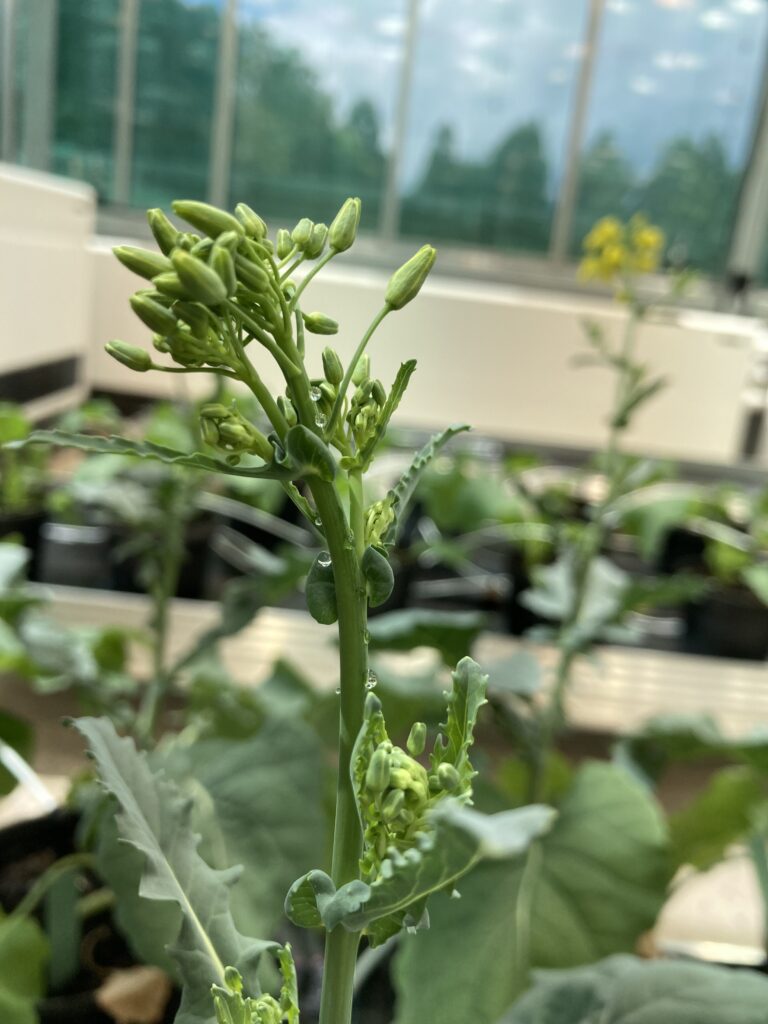
What fascinates you about plants?
What fascinates me most is that plants do not appear to be complex living beings at first glance. However, when you look more closely, their biology reveals itself to be incredibly elaborate and finely tuned, allowing them to cope with a wide range of challenging conditions despite being unable to run away from them.
In my own plant research, I am particularly fascinated by circular RNAs, a class of molecules that has only gained attention in the past decade. There are still many open questions about why they exist and what their functions are, which once again highlights how complex and multi-layered plant biology truly is.
Brian Behnken, University of Washington
Other researchers are exploring how plants balance growth against the need to defend against insects and other threats. Brian Behnken’s work examines why some bean varieties appear to maintain protection against caterpillars despite having reduced defence signalling.

What led you to explore plant defence against caterpillars?
Plants rely on defense programs to antagonize caterpillars or recruit predators to remove them, but these programs often come at the expense of growth. We discovered varieties of beans in Jujuy, Argentina with a low expression of INR (inceptin receptor), a key activator for caterpillar defense responses.
INR senses a self-peptide that is produced in the foregut of all caterpillars and is presented to the plant in their oral secretions during feeding. We wondered why 8 out of 21 lines in that region were able to proliferate with what we perceived to be a significant gap in their defense.
We identified promoter variation as the underlying factor for differences in expression, marker gene, and ethylene biosynthesis, a proxy for ascertaining INR activity. We further confirmed a significant correlation between the natural variation in four promoter haplotypes and INR expression in a heterologous wild tobacco (N. benthamiana) system.
Finally, we tested the effect of low expression on caterpillar herbivory by generating near-isogenic lines where the homozygous low-expression alleles were tested against a homozygous wild type. The results were surprising: the low-expression lines had similar defense despite their reduced INR responsiveness.
We observed that even though this subset of the Jujuy population had low expression in a key defense protein, they were still protected against caterpillars, which naturally leads to interesting questions about why higher-expression alleles are predominant in nature and not the other way around.You can read the paper Natural variation in expression of a plant immune receptor mediates elicitor sensitivity to find out more.

What fascinates you about plants?
Plants are fascinating because, for all the differences between them and mobile organisms like animals, their genetics demonstrate robust logical schemas based on their ability to distinguish self from non-self and allocate appropriate resources in response. This is evident in the research where overexpressing certain defense proteins leads to growth deficiencies or autoimmunity, hinting at the complex regulation required to keep growth and defense in check. I’m also fascinated by their ecological role in recruiting predators to eliminate threats to their communities.
They are remarkable organisms whose outer beauty reflects an equally beautiful dynamic of balance and persistence.
I am fascinated by the remarkable diversity and adaptability of plants, especially their ability to thrive under varying environmental conditions
Desu Beriso Dama
Across these PLOS One studies, a common theme emerges: plants are far more dynamic and adaptable than they first appear. Whether through microbial partnerships, molecular signalling, or finely tuned defence systems, researchers continue to uncover the remarkable strategies plants use to survive, and the many fascinating things still left to learn.
References
Kropf AL, Gassmann AJ (2026) Assessment of Beauveria bassiana as an endophyte of maize and its effects on plant growth. PLOS ONE 21(2): e0342175. https://doi.org/10.1371/journal.pone.0342175
Dama DB, Tesfamariam SA, Hassen AM (2026) Multivariate analysis for agro-morphological and quality traits in groundnut (Arachis hypogaea L.) genotypes in Eastern Ethiopia. PLOS ONE 21(4): e0347850. https://doi.org/10.1371/journal.pone.0347850
Lühmann KL, Fekete Z, Fernandes R, Kehr J (2026) Characterizing the circular RNA landscape in phloem sap of Brassica napus. PLOS ONE 21(4): e0347473. https://doi.org/10.1371/journal.pone.0347473
Behnken B, George W, Chaparro AF, Kloss-Schmidt A, Steinbrenner AD (2026) Natural variation in expression of a plant immune receptor mediates elicitor sensitivity. PLOS ONE 21(4): e0343332. https://doi.org/10.1371/journal.pone.0343332