
This blog post was prepared by PLOS One Senior Editor Joanna Tindall. The Anthropocene is a geological epoch defined by human actions…
World Ocean Day 2026
 https://worldoceanday.org/resources-type/social-media/
This blog was written by Daniel Parkes, Associate Editor in PLOS One.
The ocean is a huge carbon sink, storing 30% of the carbon dioxide emitted by human activities. It also helps to regulate our climate through the movement of ocean currents. Our oceans are incredibly biodiverse, despite an estimated 91% of ocean species remaining undiscovered [1]. Given how important the ocean is to our way of life, World Ocean Day was launched in 2002 as an annual collective day of action to promote a healthy ocean and a stable climate.
On the 8th of June, a network of individuals from over 180 countries are uniting for World Ocean Day 2026 around the theme of “Strong Marine Protected Areas (MPAs) for Our Blue Planet”. To mark the occasion, we explore some of the science published at PLOS on Marine Protected Areas, and ask our authors and editors how open science can help with the field of ocean conservation.
What are Marine Protected Areas?
Marine Protected Areas are designated regions of the ocean, established by law, protecting habitats, species, and ecological processes. This year’s World Ocean Day brings together the momentum of recent multi-year action themes, which aim to protect at least 30% of Lands, Waters, and Ocean by 2030 (30×30) through MPAs. World leaders have committed to 30×30 both within national waters and across the High Seas, an area covering two-thirds of the ocean and nearly one-half of Earth’s surface.
What does research tell us about Marine Protected Areas?
Research has shown that while Marine Protected Areas (MPAs) are useful, their effectiveness depends on how they are implemented. We spoke to authors of recently published PLOS research to examine this.
Matt Doherty (University of Plymouth, U.K) remarked that many MPAs are “paper parks,” where damaging activities, such as bottom trawling, are still allowed. Furthermore, Matt’s research [2] in Little Cayman in the Cayman Islands found that even well-enforced no-take areas experienced catastrophic coral loss during a marine heatwave, with more than half of corals dying despite strong local protection. As climate change warms the ocean, these bleaching events are expected to continue.

The impact of climate change on MPAs is not limited to rising ocean temperatures, but also shifting habitat distribution. Research led by Ryan Gasbarro (University of California, U.S.A) [3] shows how species distributions are already shifting in response to warming oceans, with suitable habitats declining or moving beyond existing MPA boundaries. This prompted calls for adaptive MPAs that can better account for future ecosystem changes. Kaila Frazer (University of New Hampshire, U.S.A) [4] further highlights this, finding the impact of extreme temperature events could also change as the climate warms. Historically, marine cold spells have harmed habitat availability for Blue Whales and Leatherback Turtles; however, future marine cold spells could actually provide refuges for these species and their prey as the ocean is projected to continue to warm as a result of climate change.

Figures from [3] left and [4] right.
The points made by Ryan and Kaila’s research was echoed by one of our PLOS One Academic Editors, John Claydon (FisherFolkFirst, Turks and Caicos Islands/Italy), who remarked: “MPAs cannot reverse the impacts of climate change [and] pollution”. John also commented on the need for equity in ocean protection. Global targets, like the 30×30 initiative, could risk disproportionately affecting small-scale fishers while leaving more industrial fisheries relatively untouched.
Together, these insights suggest that the next generation of MPAs must not just be larger in area, but better enforced, more flexible in the face of climate change, and more equitable in how their costs and benefits are shared.
Ultimately, we can either advance marine science collaboratively, or we can slow progress by keeping data locked away for individual gain. I have seen both sides of that in the field, and we know which one gives ocean conservation the best chance.
Matt Doherty
How important are open science and open data practices to the field of ocean conservation? What more can publishers do?
PLOS has been a long-standing advocate of Open Science practices. We require authors to share the data underlying their findings, helping to ensure research is transparent, reproducible, and accessible to a global community. We asked some of our authors and Editors how Open Science practices help the marine science community:
Ryan Gasbarro: “Open science and transparent data practices are important. Not only do they allow for more rigorous review from peers and the public, they are valuable tools to teach the next generation of scientists. I have certainly benefited from accessing other scientist’s data and code, and still find myself learning from these resources!”
John Claydon: “Making data transparent and available to all is very important: it makes science better by allowing results to be independently reviewed and where science was previously restricted to the individual research groups and what data they can afford to collect, the scope of science has broadened exponentially. All publishers should demand that authors must make their data publicly available from which any results presented in a manuscript were generated.”
Matt Doherty: Open science and transparent data practices are extremely important for ocean conservation. There is already a huge amount of marine data out there, but much of it remains fragmented across projects, institutions, regions and repositories. If those data are stored in meaningful, accessible and well-documented ways, they can be used far beyond the original study. That is especially important with regards to climate change, where we are often trying to understand large-scale patterns across systems, countries and time. I think this is particularly important now because we urgently need better links between science and policy. I recently attended a Caribbean policy workshop, and one thing that stood out was that several people from management and policy backgrounds felt there was not enough data to make decisions. From a research perspective, I do not think the problem is a lack of data. In many cases, there is a lot of data, but it is not always easy to access, manage, standardise or synthesise. That creates a gap between the data that exist and the information that reaches decision-makers. Publishers can help by continuing to push for open data policies across journals, but also by encouraging better metadata, clearer data standards and accessible repositories. Making data available is only the first step. Data also need to be understandable and reusable. I think journals could do more to support data papers, synthesis papers and collaborative work that brings existing datasets together in ways that are useful for conservation and policy.Ultimately, we can either advance marine science collaboratively, or we can slow progress by keeping data locked away for individual gain. I have seen both sides of that in the field, and we know which one gives ocean conservation the best chance.
Kaila Frazer: “Reading open science articles has been critical to my development as an early career researcher without consistent access to university journal subscriptions. I believe the next steps for open science publishers include strengthening code, data, and LLM- prompt sharing requirements, as well as waiving submission fees for all early career scientists.”
[Open science] makes science better by allowing results to be independently reviewed and where science was previously restricted to the individual research groups and what data they can afford to collect, the scope of science has broadened exponentially.
John Claydon
How did you get involved in ocean conservation?
We also asked for stories on how those we spoke to got into the field of ocean conservation. Ryan’s path shifted dramatically during his PhD, when the COVID-19 pandemic forced a shift to away from lab-based genetics work:
“It wasn’t until the COVID-19 pandemic in 2020 forced me to adapt my PhD research plans, changing my focus from genetics and laboratory work to computer modelling that only required a laptop, internet access, and a lot of patience in teaching myself maths and coding skills. This pivot worked for me because I was intensely curious, and it ended up making the lab work that I was able to accomplish much stronger.”
For Matt Doherty, marine science was a long-standing interest stemming from growing up near the coast and eventually diving in the Great Barrier Reef:
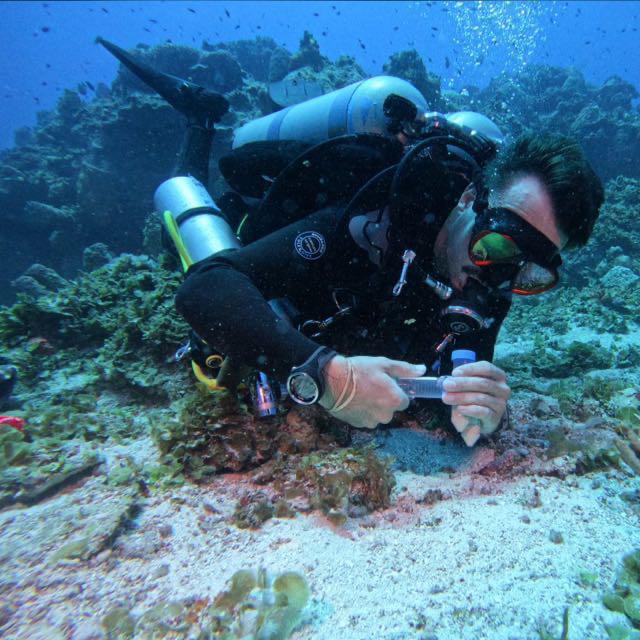
“I grew up visiting my Gran on the coast of Sunderland, [United Kingdom,] and that is where I got my love for the ocean from. My first scuba dive was in the Mediterranean when I was seven. It was a bit less regulated back then. There is still a photo of me sat on the back of a boat in full scuba gear, looking terrified, which does the rounds at family parties. When I was 18 and playing rugby in Australia at the University of Queensland, I went diving on the Great Barrier Reef one weekend, and it all snowballed from there really. I came home, went to university in Swansea, and never looked back. I probably owe a lot to one of my former lecturers, Dr Nicole Esteban, who gave me my first real step into the field by helping organise an internship in Sint Eustatius, [Leeward Islands,] after graduation. Since then, I have been lucky enough to work around the world, and I am enjoying an exciting career so far.”
Reading open science articles has been critical to my development as an early career researcher without consistent access to university journal subscriptions.
Kaila Frazer
What advice would you give to Early Career Researchers?
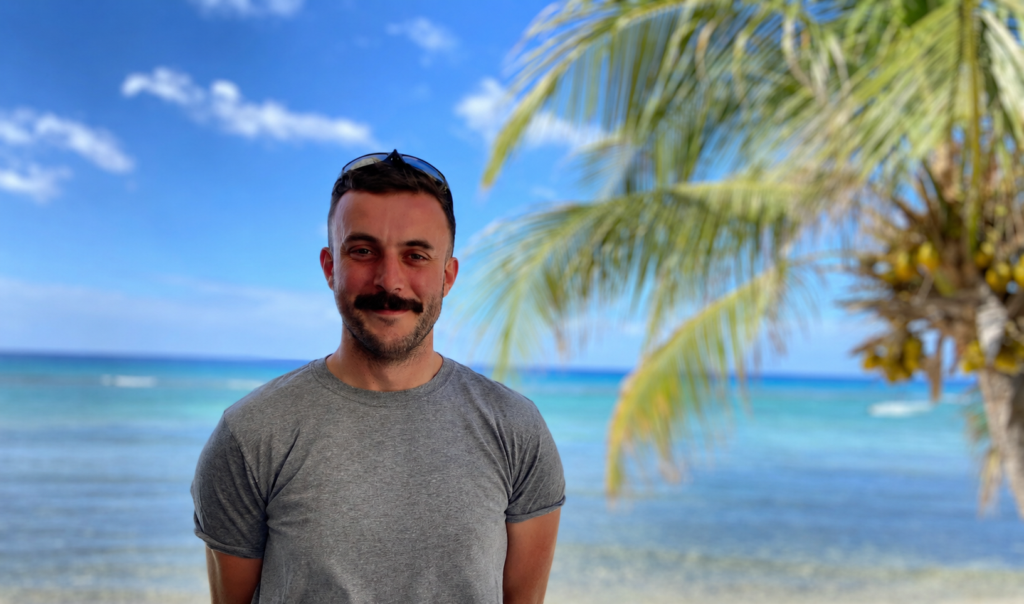
Matt: I would say: be good to work with, be useful, and be someone people trust. Marine science is a small world, and fieldwork especially depends on people who can work hard, get on with others, and deal with things not going to plan. Use your networks, and do not be disheartened when people say no. Everyone gets ignored, rejected or turned down at some point. Try again. I would also recommend building strong writing and quantitative skills. Being reliable both in the field and at the analysis stage makes you much more useful to a team.

Ryan: “My main advice would be to stay curious and adaptable. Very few scientists I know followed linear paths in their careers…Also, don’t be afraid to ask for help. Scientists tend to be passionate about what they do, and this passion often translates into an eagerness to share knowledge and see the next generation of scientists carry their field forward. I have been lucky to have great mentors in my career, and I continue to learn every day from colleagues and collaborators.”

Kaila: “I am currently a PhD student, so I ask this question for myself often! I am grateful to the NOAA Lapenta Internship program which enabled me to do the research I recently published in PLOS Climate, and I encourage undergraduate students to pursue government research internships as I did.”
Be good to work with, be useful, and be someone people trust…do not be disheartened when people say no. Everyone gets ignored, rejected or turned down at some point. Try again!
Matt Doherty
What advice would you give to the public for protecting the world’s oceans?
In the spirit of World Ocean Day as a collective day of action, we asked what advice researchers had for the public.
For Ryan, that starts with active participation:
“Get involved! There are so many ways to learn about the ocean, and get involved in citizen science. I think this is super exciting. You can go to your local beach and use the iNaturalist app on your phone to document what you find, and this data may just end up in a scientific study, as researchers are using citizen science data more and more these days. If you don’t have access to the ocean, there are still ways to be involved. For example, you can follow along and even interact with livestreams exploring the frontiers of the deep ocean (e.g. from Schmidt Ocean Institute or the E/V Nautilus).”
Matt commented on the need for collective action:
“Advocate for your local areas. Hold decision-makers to account, and push for climate action at the source. We cannot simply adapt or restore our way out of this. We need to reduce fossil fuel use, challenge weak environmental policy, and stop treating climate change as something that can be solved by individual lifestyle choices alone.”
Kaila said individual and collective action go hand-in-hand:
“I believe that the best way to protect the world’s oceans is to reduce the anthropogenic carbon emissions which are driving global climate change. This mission goes hand and hand with the need to reduce plastic waste in the ocean. Shifting our cultures and policies away from fossil fuel and plastic consumption, therefore, is the highest impact action we can take to protect marine organisms.”
References
- Mora C, Tittensor DP, Adl S, Simpson AGB, Worm B (2011) How Many Species Are There on Earth and in the Ocean? PLoS Biol 9(8): e1001127. https://doi.org/10.1371/journal.pbio.1001127
- Doherty ML, Johnson JV, Goodbody-Gringley G (2025) Widespread coral bleaching and mass mortality during the 2023–2024 marine heatwave in Little Cayman. PLoS One 20(5): e0322636. https://doi.org/10.1371/journal.pone.0322636
- Gasbarro R, Ainley DG, Andrews KS, Ballance LT, Blondin H, Bograd S, et al. (2025) Projected changes to the extent and seasonality of seabird habitat in the California current and implications for marine spatial planning. PLOS Clim 4(11): e0000687. https://doi.org/10.1371/journal.pclm.0000687
- Frazer KJ, Welch HM, Jacox MG, Lezama-Ochoa N, Abrahms B, Pozo Buil M, et al. (2025) Marine cold-spells in the California Current System: Modeling changes in frequency and impacts on endangered species habitat. PLOS Clim 5(1): e0000563. https://doi.org/10.1371/journal.pclm.0000563